What Really Defines a Connected Vehicle? Beyond GPS, Apps, and OTA Updates
MODERN VEHICLE = DATA CENTER ON WHEELS
Most people think a “connected vehicle” or “modern vehicle” is little more than a car with GPS, a mobile app, or the ability to receive over-the-air updates. That perception is not only outdated – it’s dangerously incomplete. In 2025, a connected vehicle is a live, distributed computing system that constantly interacts with cloud platforms, roadside infrastructure, other vehicles, and service ecosystems.
Understanding this reality is the first step to understanding the opportunities and risks that define the future of the automotive industry.
1. A Connected Vehicle Is Defined by Continuous Data Exchange
A modern vehicle is no longer a mechanical machine augmented with electronics. It is a continuous data emitter and receiver, sitting inside an ecosystem of digital interactions.
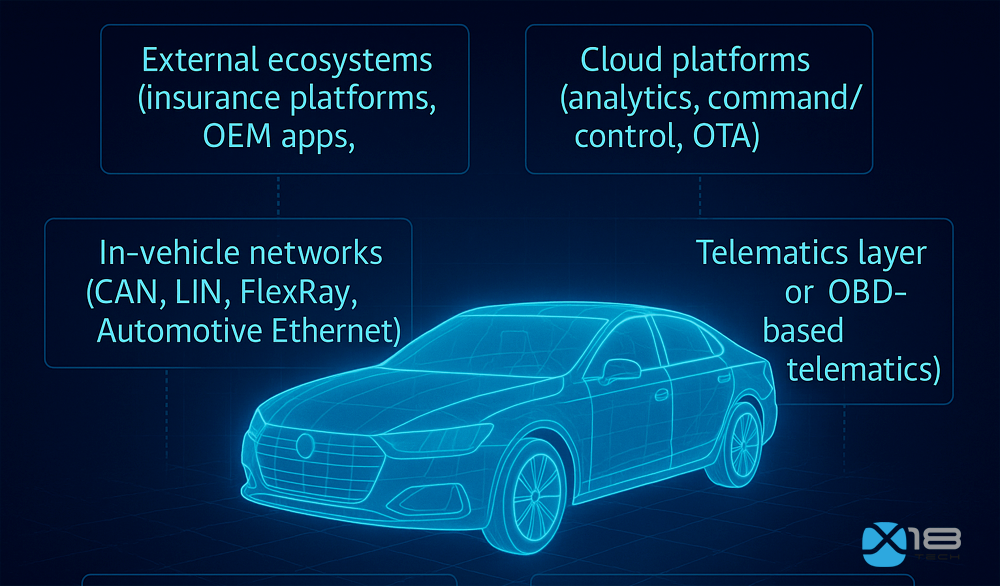
A connected vehicle typically communicates across four layers:
- In – vehicle networks (CAN, LIN, FlexRay, Automotive Ethernet)
- Telematics layer (TCU or OBD-based telematics)
- Cloud platforms (analytics, command/control, OTA)
- External ecosystems (insurance platforms, OEM apps, charging networks, government services)
This structure enables new business models, real-time monitoring, advanced diagnostics, and AI-driven insights that would be impossible 10 years ago. But it also expands the attack surface exponentially.
2. The Misconceptions That Hold the Industry Back
The automotive world has been slow to update its mental model. Three misconceptions persist:
Misconception 1: Connected vehicles are a “premium feature.”
In reality, connectivity is now a regulatory and commercial necessity. Safety functions, cybersecurity monitoring, emissions reporting, and fleet optimization all depend on data continuity.
Misconception 2: Connectivity = GPS + mobile app
GPS is only 0.1% of the vehicle’s data output. A single car produces 2–5 million messages per day on internal networks, carrying vital information about braking, steering, battery, torque, thermal systems, and more.
Misconception 3: OTA makes the vehicle “smart enough”
OTA is useful, but without cybersecurity monitoring, anomaly detection, and secure data governance, OTA becomes an attack vector rather than an advantage.
3. The Value Chain Enabled by Connectivity
Connectivity unlocks value in ways mechanical engineering alone never could:
- Predictive maintenance reduces unplanned downtime and can save fleets 30–50% in maintenance costs.
- Telematics-based insurance (UBI) rewrites how insurers price risk.
- Fleet optimization algorithms improve routing, fuel efficiency, and safety.
- Cybersecurity monitoring (VSOC) becomes essential as attacks move from physical access to remote exploitation.
- Software-defined business models unlock recurring revenue streams for OEMs.
Connectivity is not a feature. It is the substrate of all future automotive value creation.
4. Connectivity Also Defines the New Risk Landscape
Every connection increases value – but also increases vulnerability:
- Remote attackers can exploit infotainment, Bluetooth, Wi-Fi, or 4G/5G modems.
- APIs between mobile apps and vehicle backends have become a major weakness.
- EV charging networks introduce high-power cyber-physical risks.
- OBD dongles or after-market devices can become entry points if unsecured.
Connected vehicles cannot exist without cybersecurity. That is why global regulations (UNR 155, ISO/SAE 21434) now mandate continuous cybersecurity monitoring throughout the lifecycle of the vehicle.
5. The Role of x18 Technology
Because connected vehicles rely on persistent telematics and cybersecurity, x18’s product ecosystem aligns exactly with industry needs:
- OBDx enables secure data acquisition from any vehicle.
- ForeFix transforms raw telematics data into actionable predictive maintenance.
- x18 VSOC provides continuous cybersecurity oversight, in line with UNR 155.
- VulnCar enables deep vulnerability scanning at the ECU and firmware level.
A connected vehicle is not defined by its “features”. It is defined by its data, its interactions, and its exposure.
Understanding that reality is the foundation of understanding telematics and automotive cybersecurity.